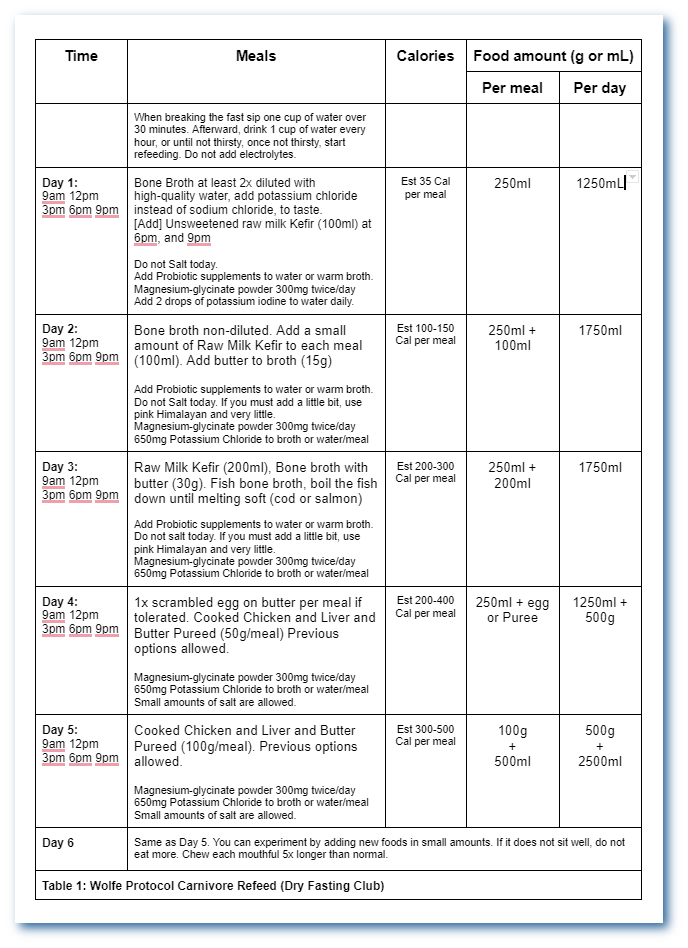
This protocol is a big overhaul of the previous carnivore protocol with hundreds of new insights and experiences that have been built upon it.
Refeeding as a carnivore-style diet after a dry fast is not the optimal way to refeed, but knowing this, there are hacks and strategies to make it possible and harness its unique powers. A high protein, primal energy-focused refeed.
The protocol involves foods, strategies, and timelines, this protocol will be constantly evolving over the year.
To view the information below, make sure you have a paid subscription.
If you've been on the carnivore diet for a while and are looking for a safe and effective dry fasting refeed the Carnivore Refeed has got you covered. Specially designed for those whose bodies still struggle with carbs, this carnivore-refeed method ensures a gentle transition back to regular eating, while maintaining the core principles of the carnivore lifestyle.
The refeed starts with water rehydration – drinking a cup of water over 30 minutes, followed by a cup every hour until thirst is quenched. Next, bone broth is introduced, as it's one of the most easily digestible, nutrient-rich, and warming foods for carnivores.
Probiotics play a crucial role in the first day of the refeed, as they help restore gut health after a serious depletion. IMPORTANT. They can be mixed into water or broth when it's not too hot, to avoid ingesting the capsule while the digestive system is waking up. Magnesium and glycine are also recommended to replenish magnesium levels and promote relaxation during the refeeding process, which can be mentally challenging.
Probiotics can be mixed into water or broth when it's not too hot, to avoid ingesting the capsule while the digestive system is waking up
The Crossroads of Carnivore Diets
The carnivore diet presents two main groups. The first strictly eats only meat. Within this group, some eat only beef, while others have a variety of meats and animal products. The second group is more flexible, including various meats but also allowing eggs, dairy, and even coconut oil. We can call these two approaches 'animal-based carnivore' and 'strict carnivore.'
Adding elements like kefir, especially when reintroducing food after a fast, is important. Yet, this often leads to mixed feelings, with some people being doubtful or completely against it. I aim to create a space that respects these different opinions.
Though the carnivore diet has ancient roots, it's only recently become a subject of scientific study. This means there's a lot we don't know, especially about its possible downsides, even though many find it beneficial. My method is cautious and logical. I want to maintain a healthy gut and make the most of a low-carb diet safely and knowledgeably.
This approach comes from my own trials and conversations with others who follow the carnivore diet and practice dry fasting. It's essential to understand that while these methods and ideas are helpful starting points for more questions and studies, they're not perfect or completely safe. They're meant to deepen our understanding and encourage more research and discussion.
Strict Carnivore
Overview:
- You start off with bone broth. Keep it diluted as a spike in protein can be just as bad if not worse than a large glucose spike early on in the refeed.
- You can keep in the broth stage for a long time until you feel you are ready to move on to meat. Meat cuts should be as soft as possible. What I mean by this is that a slow cooker-style meat preparation is ideal, because you want to make the meat as digestible as possible by shortening the complex protein chains.
- Stay off of sodium-based salt for a few days and then slowly titrate back up.
- Probiotics are interesting, and I recommend them as a safeguard, although scientifically, without fiber as a prebiotic, these may be worthless. Acidophilus and lactobacillus.
- Highly recommend Betaine HCl with your meals to help digest the protein early on as the liver enzymes are restarting. The Betaine also deals with homocysteine levels.
- Avoid frying the meat early on or burning it, to avoid the Maillard reaction. Digestibility is key early on.
Animal-Based Carnivore
Overview:
- You start off with bone broth. Keep it diluted as a spike in protein can be just as bad if not worse than a large glucose spike early on in the refeed.
- You can keep in the broth stage for a long time until you feel you are ready. Your next stage will be to move on to kefir, which is one of the most digestible foods and the highest in beneficial probiotics on the planet.
- Stay off of sodium-based salt for a few days and then slowly titrate back up.
- Your next jump will be to eggs. The ideal way to prepare them is to make slightly wet scrambled eggs or to make soft-boiled eggs.
- Following eggs, you move on to fish, followed by chicken, and then beef, pork, and lamb.
- Slow cooker-style meat preparation is ideal because you want to make the meat as digestible as possible by shortening the complex protein chains.
- Avoid frying the meat early on or burning it, to avoid the Maillard reaction. Digestibility is key early on. Baked fish for example is preferred to fried fish.
- When frying or adding fat to meals early on you can consider coconut oil as a very digestible, and good fat source before you move on to butter or animal fat.
- Highly recommend Betaine HCl with your meals to help digest the protein early on as the liver enzymes are restarting. The Betaine also deals with homocysteine levels.
36-Hour Growth Hormone Ultimate Strategy
I've got a crazy one for you that I'll be working on fleshing out. I use a strategy that involves a 36-hour dry fast into a workout and sauna session that blows growth hormone out of the water. It's the ultimate NATURAL steroid for muscle growth. If you can harness this correctly, you can get results in a couple of months that would normally take years to achieve.
Click Here for Nature's Steroid Dry Fasting Protocol.
Old Carnivore Protocol and Why It's outdated